Overview
What the project is designed to do
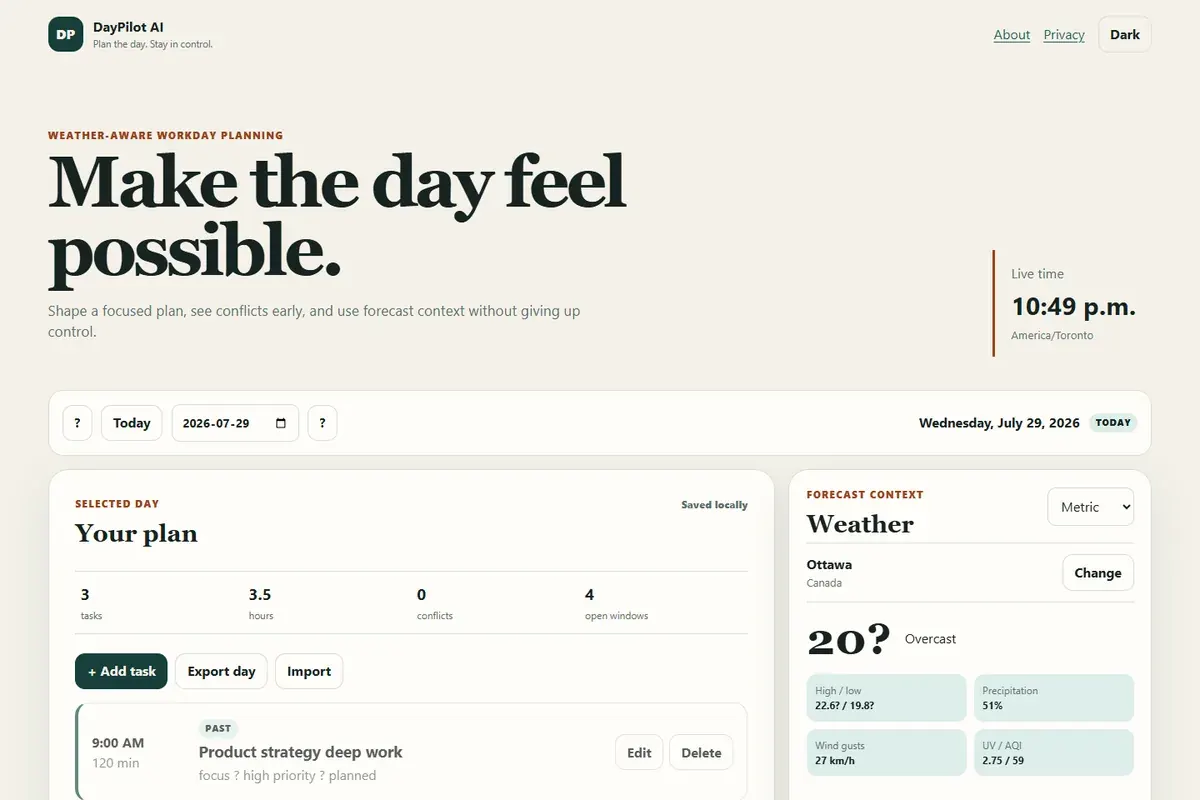
A local-first, weather-aware workday planner with flexible tasks, date isolation, conflict and free-window analysis, and review-only planning proposals.
Tasks support fifteen-minute timing, priority, category, notes, status, and weather sensitivity while versioned local storage provides migration, import, export, and undo.
Open-Meteo context and optional AI wording feed a guarded proposal flow that must be previewed and revalidated before the user applies it.
Problem
What needed to change
Simple hourly schedulers do not explain overlaps, workload, weather trade-offs, or what an automated planning suggestion would change.
Solution
How the release responds
Model the workday as local user-owned data, calculate conflicts and free windows deterministically, and keep every suggested schedule change behind explicit review.
Key features
What visitors can use
- Flexible fifteen-minute tasks
- Conflict, workload, and free-window analysis
- Opt-in weather and air-quality context
- Reviewable planning proposals
- Versioned local data with import, export, and undo
Implementation
How it was built
- 01
Next.js App Router and TypeScript separate planner-domain logic from presentation.
- 02
Server route handlers normalize Open-Meteo data without exposing credentials.
- 03
A deterministic assistant remains available when the optional AI SDK path is disabled.
Architecture
Delivery shape
A Next.js application keeps planner data in the browser and uses narrow route handlers for normalized weather context and optional proposal wording.
Product boundary
What this release does not claim
- No accounts, database, analytics, ads, background location, or assistant history
- The assistant cannot autonomously change a calendar and weather context is not an official warning